


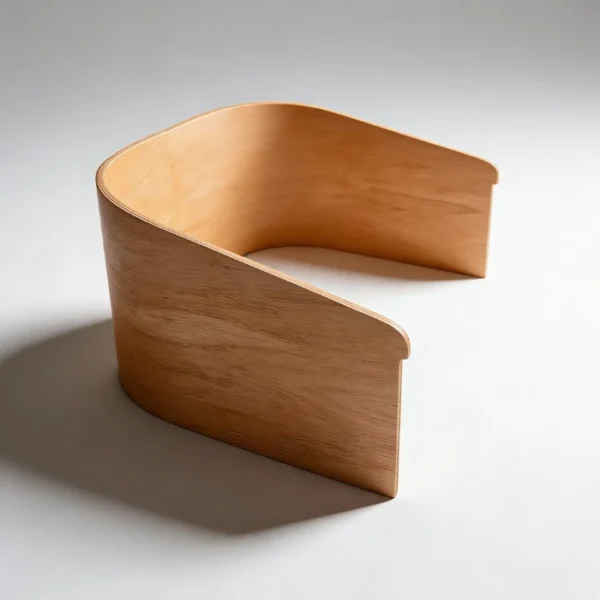
Sofa Curved Arm and Back Rail
The visible curved rail on a sofa is the part customers touch first, so the curve has to be true.
On a sofa the arm and back rail are the parts a customer actually touches and sits against, so the curve has to stay true along its whole length. A rail that runs out of curve by the middle of a long span looks wrong from across a room even when it is within tolerance. We press full-length sections in matched tools to hold the curve.
Quick Specifications
| Material | Birch plywood or mixed-core laminated plywood |
|---|---|
| Lay-up | 9 to 15 plies |
| Section thickness | 15 – 25 mm |
| Rail height | 200 – 450 mm |
| Length per section | 600 – 1200 mm, jointed for longer runs |
| Form | Press-moulded compound curve, radius 4:1 – 10:1 |
| Finish | Clear lacquer, PU, or stain to colour |
| Overall tolerance | ±0.5 mm on joint and fixing faces |
Holding the curve over length
A rail that is correct at both ends can still lose curve in the middle, so we form sections at a length the tooling can hold and machine the joint to a common datum. That way the assembled rail reads as one continuous curve rather than three slightly different ones.
Why plywood suits sofa rails
A sofa arm is a cantilever in use. Moulded plywood gives the section depth needed to resist the load without the weight of a solid timber rail, and it takes a curve that a solid section could not hold at this profile.
Matching an existing rail
If you are replacing a supplier, send a sample and we will match the section, the curve and the fixing positions rather than only the length.
Request a quote
Send your drawing, sample or dimensions and we will confirm feasibility, tooling, MOQ and lead time. Prototypes typically run 7-15 days and production orders 15-30 days.


Reviews
There are no reviews yet.