


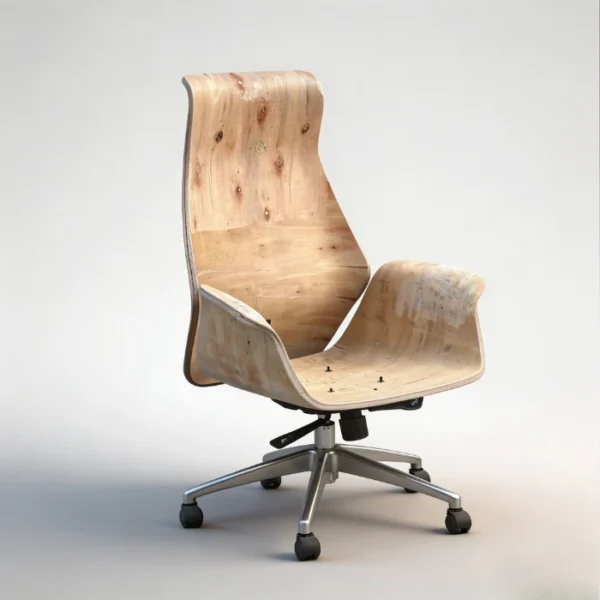
Office Chair Moulded Shell with Lumbar Curve
A work chair shell with a formed lumbar curve, built for eight-hour days rather than showrooms.
An office chair shell has to do more than look right. It has to support a loaded sitter through a working day, take repeated adjustment loads, and still be a moulded curve rather than a flat panel with padding. We form the lumbar into the shell so support comes from the geometry, not from foam thickness.
Quick Specifications
| Material | Birch plywood or mixed-core laminated plywood |
|---|---|
| Lay-up | 11 to 15 plies for load paths |
| Shell thickness | 10 – 15 mm |
| Seat pan width | 430 – 520 mm |
| Lumbar rise | 20 – 60 mm formed into the shell |
| Form | Press-moulded compound curve with formed lumbar |
| Load orientation | Cross-banded so the seat pan takes compression, not bending |
| Overall tolerance | ±0.5 mm on machined faces |
Formed lumbar versus foam lumbar
A formed lumbar keeps the seat pan thickness constant, so the chair profile reads the same front to back. Foam sits on top and compresses differently in the lumbar zone than at the front edge, which is why foam-lumbar chairs feel uneven after a few months.
What the shell has to carry
The seat pan works in compression and the back in tension along the grain. We cross-band the lay-up so those loads run across plies rather than between them. For BIFMA-tested constructions we supply test samples with the batch.
Mechanism interface
Send us your mechanism model and we will machine the mounting features into the shell before finishing, so there is no drilling into a finished surface at your line.
Request a quote
Send your drawing, sample or dimensions and we will confirm feasibility, tooling, MOQ and lead time. Prototypes typically run 7-15 days and production orders 15-30 days.


Reviews
There are no reviews yet.