


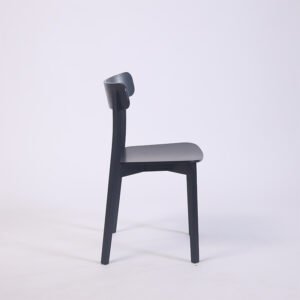
Our bentwood chair frame pairs a steam-bent white ash structural frame with mixed-hardwood backrest and seat elements — a construction chosen for the way chair frames actually fail. The ash frame carries the grain continuously around every curve, so the load a sitter applies is carried by unbroken timber rather than by a glue line at a corner. The mixed-hardwood elements keep the programme economical where the section does not need ash’s elasticity.
Why this construction
A chair frame assembled from straight segments has a joint at every corner — and each joint is both a stress concentrator and, eventually, a crack line in the finish. Steam bending removes those corners from the frame itself: the rear legs, back frame and stretchers are bent to your drawing with the grain following the curve. The result is fewer parts, less assembly labour, and a frame that flexes with the sitter instead of failing at the joint. It is the reason bent frames remain standard in contract seating that must survive years of daily use.
Specifications
| Frame material | White ash — steam-bent, continuous grain |
| Backrest & seat | Mixed hardwoods, matched to your specification |
| Construction | Solid steam-bent frame; other constructions available |
| Dimensions | Custom to drawings; CNC accuracy within ±0.5 mm |
| Finishes | Raw, sanded, oiled, stained or lacquered |
| MOQ | Low — prototype from 1 piece |
| Lead time | Prototype 7–15 days · bulk 15–30 days |
| Certification | FSC/PEFC materials available |
Who this frame suits
- Dining and café seating programmes — slender ash frames that pass strength testing at low section weights.
- Contract seating — frames engineered for the cycle counts in ANSI/BIFMA X5.1 and EN 16139.
- OEM chair makers — frames supplied to your drawing for your own upholstery and assembly.
- Replacement programmes — frames matched to originals for classic designs and refresh cycles.
Material notes
Ash is specified for the frame because it is elastic and shock-resistant — it tolerates tight radii in slender sections and absorbs the flexing that seating endures. Where a programme needs a different surface, the same frame can be built in beech for painted finishes or with walnut elements for premium programmes. Species selection is confirmed against your drawing at quotation stage.
Quality and process
Frames are bent, dried in their forms, then CNC-machined to final dimensions within ±0.5 mm. Every frame passes a six-stage inspection covering moisture content, joint integrity, dimensions and surface finish, with reports supplied on request. Tooling — the moulds and jigs — is built in-house and remains yours, so a design change between prototype and production is a tooling update rather than a new supplier relationship.
Ordering
Send the frame drawing with the target section, finish and quantity, plus any test standard the finished seating must meet. We confirm feasibility, quote within 24 hours, and deliver prototypes in 7–15 days. See also our bent wood chair frames capability page and the solid bent wood range.
Ready to start your project? Send your drawings, samples or specifications through our contact page and receive a quotation within 24 hours. Prototypes are delivered in 7–15 days and bulk orders in 15–30 days.
Design considerations for bent frames
Three decisions at the drawing stage decide how well a frame can be bent — and how it behaves in service:
- Radius against section — every species has a minimum radius for a given thickness. A 12 mm ash section bends comfortably where a 12 mm walnut section would not. If your design needs a tight curve, either accept a thinner section or move to a laminated construction.
- Grain direction — the blank must be cut so the grain runs along the curve. A frame drawn without regard to grain direction will fail at the shoulder regardless of how well it is bent.
- Upholstery and assembly — frames that will be upholstered need flat lands for the padding to attach to, and frames that assemble with hardware need drilled and countersunk points. Both are machined after bending, so they belong on the drawing.
Bent vs jointed: a practical comparison
| Bent frame | Jointed frame | |
| Grain | Continuous around the curve | Cut across at every corner |
| Stress | Distributed along the curve | Concentrated at each joint |
| Finish durability | No glue line to crack | Finish cracks along joints over time |
| Parts and labour | Fewer parts, less assembly | More parts, more joints to make and inspect |
| Material use | Less waste at generous radii | Segments cut from straight stock |
Quality control for frame programmes
Frame programmes live or die on consistency: a frame that varies 2 mm between batches costs your assembly line rework. Our controls are built around that — dimensional checks to ±0.5 mm after machining, moisture verification before finishing, and joint integrity checks on every frame. Inspection reports accompany each shipment so your incoming QC can trace any issue to a stage.
From drawing to delivery
- Quotation and feasibility — within 24 hours of receiving the drawing. Radius, section and species are confirmed here, and anything that will not bend reliably is flagged.
- Prototype — 7–15 days. The form is built, the first frames are bent, dried, machined and finished, and shipped for your approval.
- Production — 15–30 days after sample approval, with six-stage inspection and reports before shipment.
- Repeat supply — documented tooling and stable processes keep repeat runs consistent, batch after batch.
Packaging and shipping
Frames are packed to protect the curve: shaped cartons or crates that support the frame along its length, with corner protection at the bends. We ship globally, with regular programmes to the EU, US and Southeast Asia, and every shipment carries a full warranty against warping and cracking in transit and use.
Frequently asked questions
Can you make this frame to our own design?
Yes — the frame shown is a representative build. We manufacture to your drawings, CAD files or samples, confirming section, species and radius before tooling.
What tolerances can you hold?
CNC machining delivers dimensional accuracy within ±0.5 mm on finished dimensions, and every frame is checked for moisture content and joint integrity before shipment.
Do you supply small quantities for prototypes?
Yes — low MOQ is supported: prototypes in 7–15 days, production runs in 15–30 days.
Can you replicate an existing frame?
Send the original frame or a sample and we will match the profile, section and finish — common for classic seating programmes and contract refresh cycles.
What finishes are available?
Raw, sanded, oiled, stained or lacquered. Surface preparation is confirmed on the approved sample before production.
Quick Specifications
| SKU | JX-SBW-ASH-02 |
|---|---|
| Material | White Ash |
| Process | Steam bending (solid wood) |




Reviews
There are no reviews yet.