


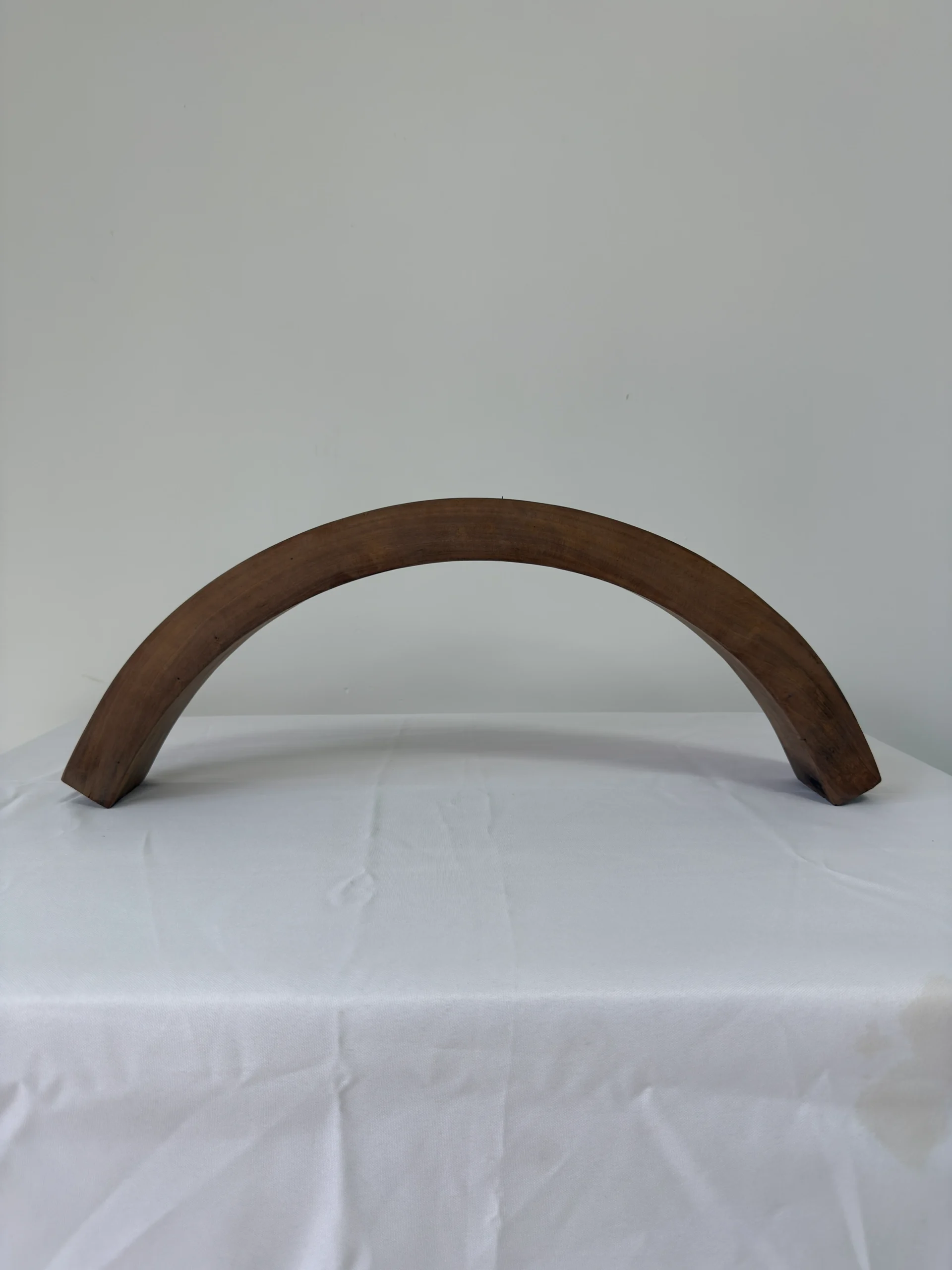
Lighting asks for two things that pull against each other: the thinnest possible sections for a light appearance, and long-term dimensional stability. Bent wood does both better than routed solid timber, because the grain follows the curve and no end grain appears in the section.
Parts we make for lighting
Rings and holders
Closed rings for pendant and ceiling fixtures from 200 to 1,200 mm diameter, section 8 to 20 mm. The ring is bent in one piece or joined from two halves. Bent wood lighting components
Arcs and free forms
Quarter arcs, teardrop shapes and irregular contours for designer fixtures, including multi-axis bends. Bent wood arch components
Diffuser frames and slats
Bent slats and frames for louvred and shade fixtures, 0.8 to 4 cm thick, evenly spaced. Bent wood slats
Thin sections, radii and heat
Thin sections bend tighter: at 6 mm thickness radii from about R60 are possible with a steel strap, at 12 mm from about R120. The limit is not the machine but the strain on the outer fibre — which is why we always bend thin rings with a strap.
LED heat is uncritical for wood, less so for the finish. In closed fixtures the timber reaches 45 to 55 °C. Oil-wax finishes handle that without yellowing; high-gloss lacquer can darken under sustained heat. We match the finish to the fixture concept, not only to the look.
Roundness is checked against a template, ±0.5 mm on diameter. What holds the shape over time is moisture content: we ship at 8 to 11 percent, and the ring keeps its form even in dry room air.
Tooling, MOQ and lead time
Ring tooling is built in-house in 7 to 15 days from drawing and archived for the life of the programme. For lighting the minimum is usually lower than in furniture because the parts are small — a simple frame pays off from a few hundred pieces. Production runs 15 to 30 days; FOB Foshan or Shenzhen.
Rings are nested and packed with form inserts so they do not go oval in transit. Multi-axis twisted arcs are made in a split tool, otherwise the part cannot be released from the mould. Quantities and dates under MOQ, lead time and shipping.
Frequent questions
How thin can a bent wood ring be?
From about 4 mm wall thickness a ring is feasible; 6 to 12 mm is typical. Below 6 mm the reject rate rises because the outer fibre is strained harder.
Does bent wood warp under LED heat?
The wood does not, the finish can. At 45 to 55 °C on the part we recommend oil-wax rather than high-gloss lacquer, which darkens under sustained heat.
How round does a ring stay across a run?
Every ring is checked against a template, ±0.5 mm on diameter, provided the wood is conditioned to 8 to 11 percent and the tool is archived.
Terms: bend radius, springback and case-hardening are explained in the bent wood glossary. Send a drawing with radius and section and we confirm feasibility, tooling and lead time within 24 hours via the contact page.
Application examples: six parts with their production parameters — see the examples.